Handbag „Petra“
How a Straightforward Handbag Became a Proper Workshop Lesson
Petra began with what looked like a fairly clear request.
A medium-sized leather handbag. Elegant, classic, practical. Two handles long enough to carry over the shoulder, no separate shoulder strap, one main compartment, one smaller zippered pocket inside. Dark brown outside, lighter inside. Structured enough to stand on its own, but not so stiff that it felt like a satchel.
On paper, it sounded almost modest.
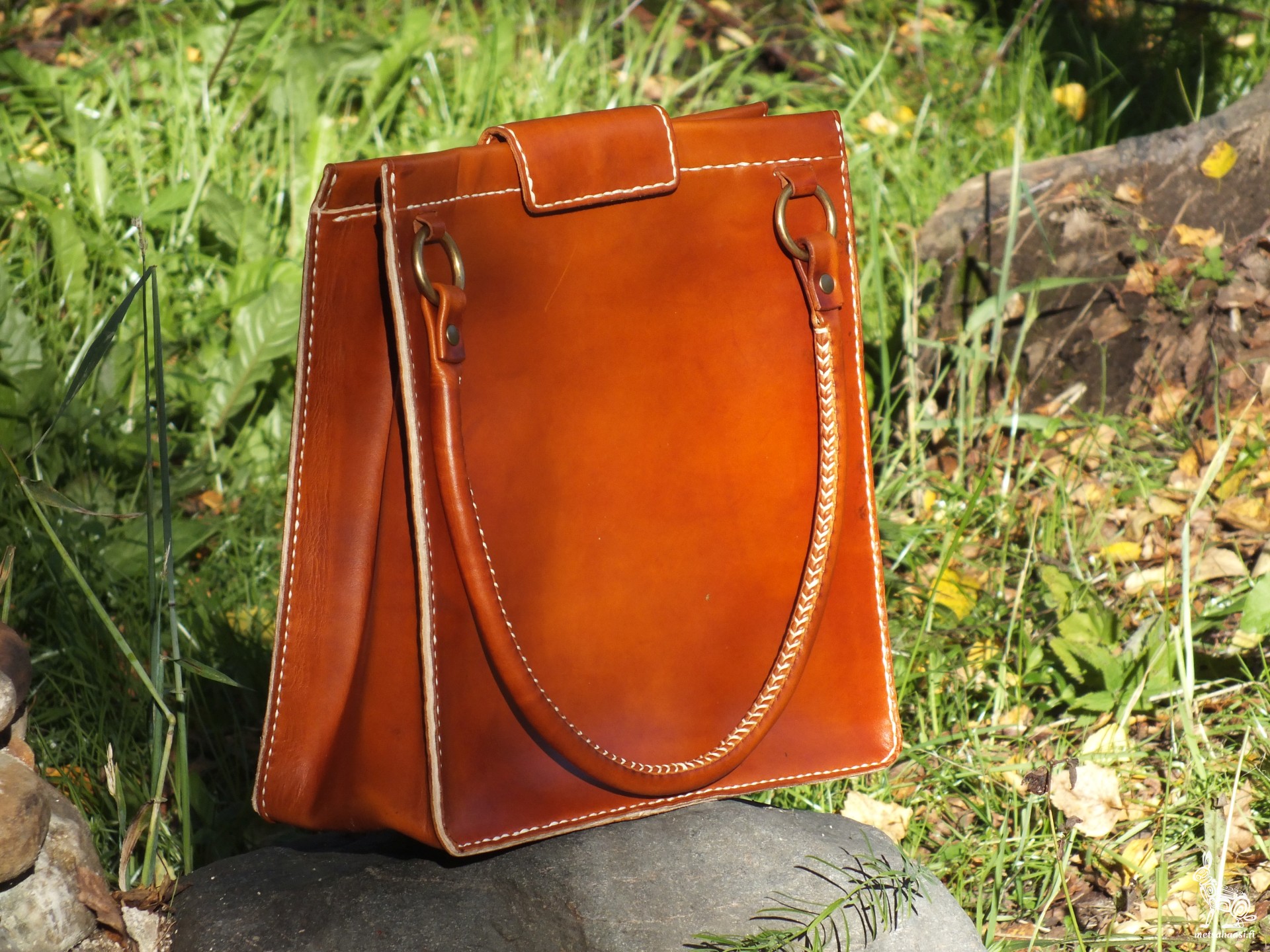
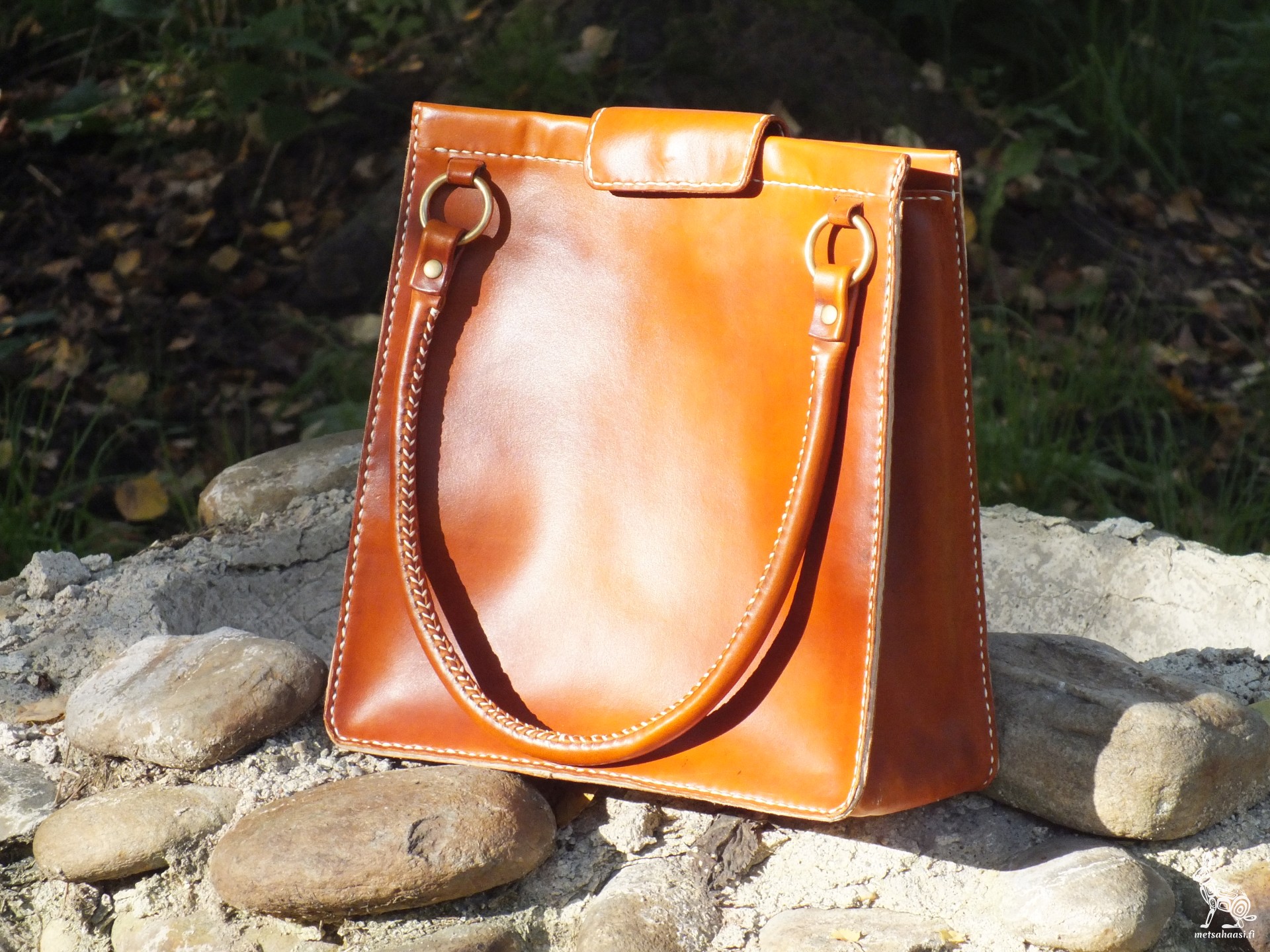
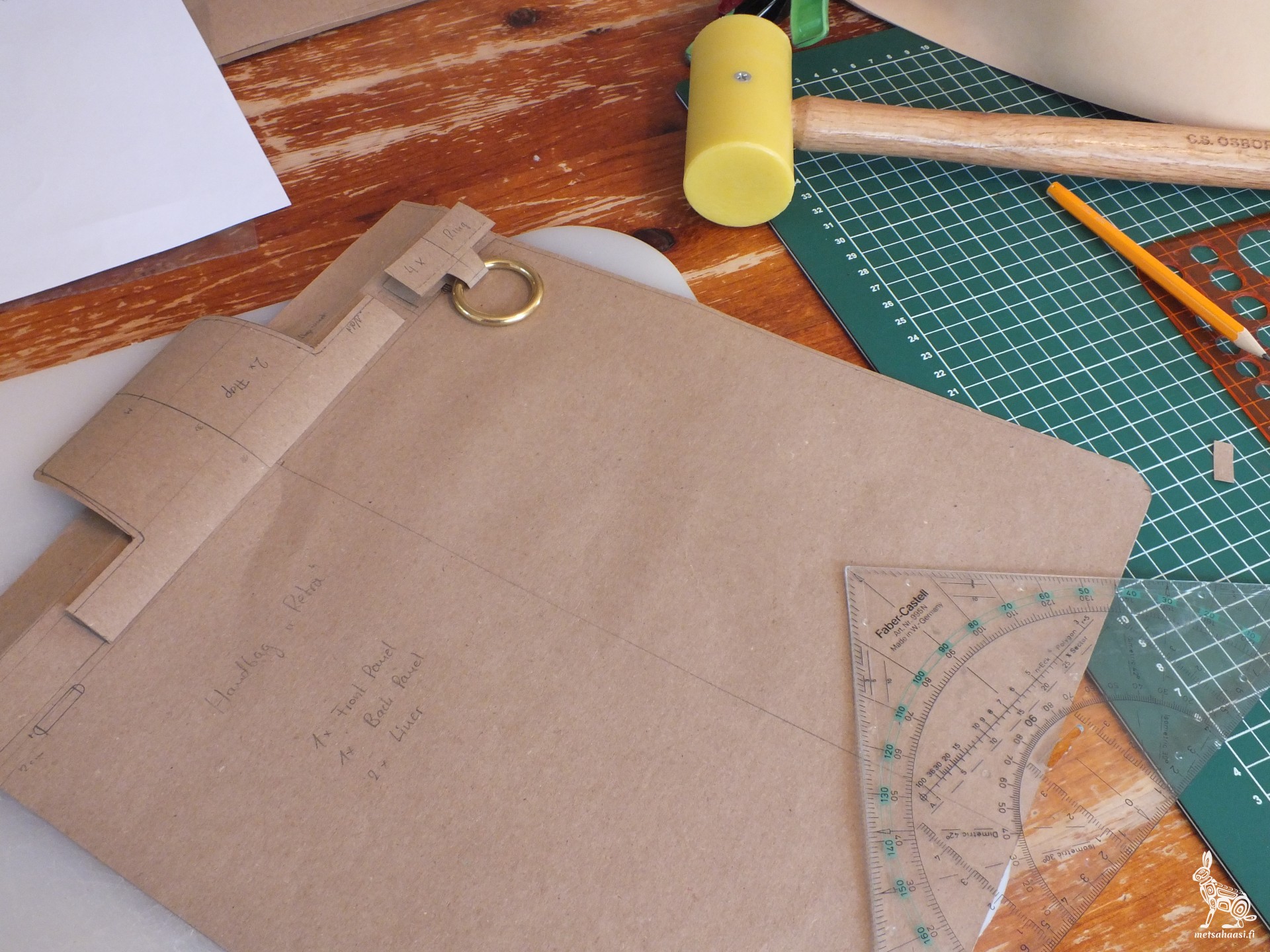
The first design sketches followed that simplicity. Two main leather panels, one gusset between them, a folded top edge, rolled handles and a small inner pocket. The body would be slightly wider at the bottom than at the top, just enough to avoid the rigid boxiness of a square tote. The exterior would be vegetable-tanned cowhide, dyed English Bridle, with a lighter natural goatskin lining and brass hardware.
The intention from the beginning was not to imitate a soft fashion tote. Petra was supposed to feel more like an heirloom object: quiet, useful, sturdy, elegant and capable of becoming better with age.
That part stayed true.
Almost everything else took some negotiation with reality.
The first reminder came during dyeing. Once the English Bridle colour went onto the pale vegetable-tanned leather, a scattering of nearly black freckles appeared in some areas. They were too irregular to be dye splashes and too dark to be normal variation. The likely culprit was tiny traces of iron contamination reacting with the tannins in the leather.
Nothing catastrophic, but enough to teach a useful lesson: natural vegetable-tanned leather remembers everything. A slightly dirty work surface, invisible workshop dust, a metal particle you never noticed. Sometimes the hide waits until the dye goes on before telling you what happened.
Then came the handles.
Rolled leather handles seemed straightforward enough in theory. In practice, getting them to look elegant, sit comfortably in the hand and attach cleanly to the brass rings took three attempts.
The final answer turned out to be the simplest one.
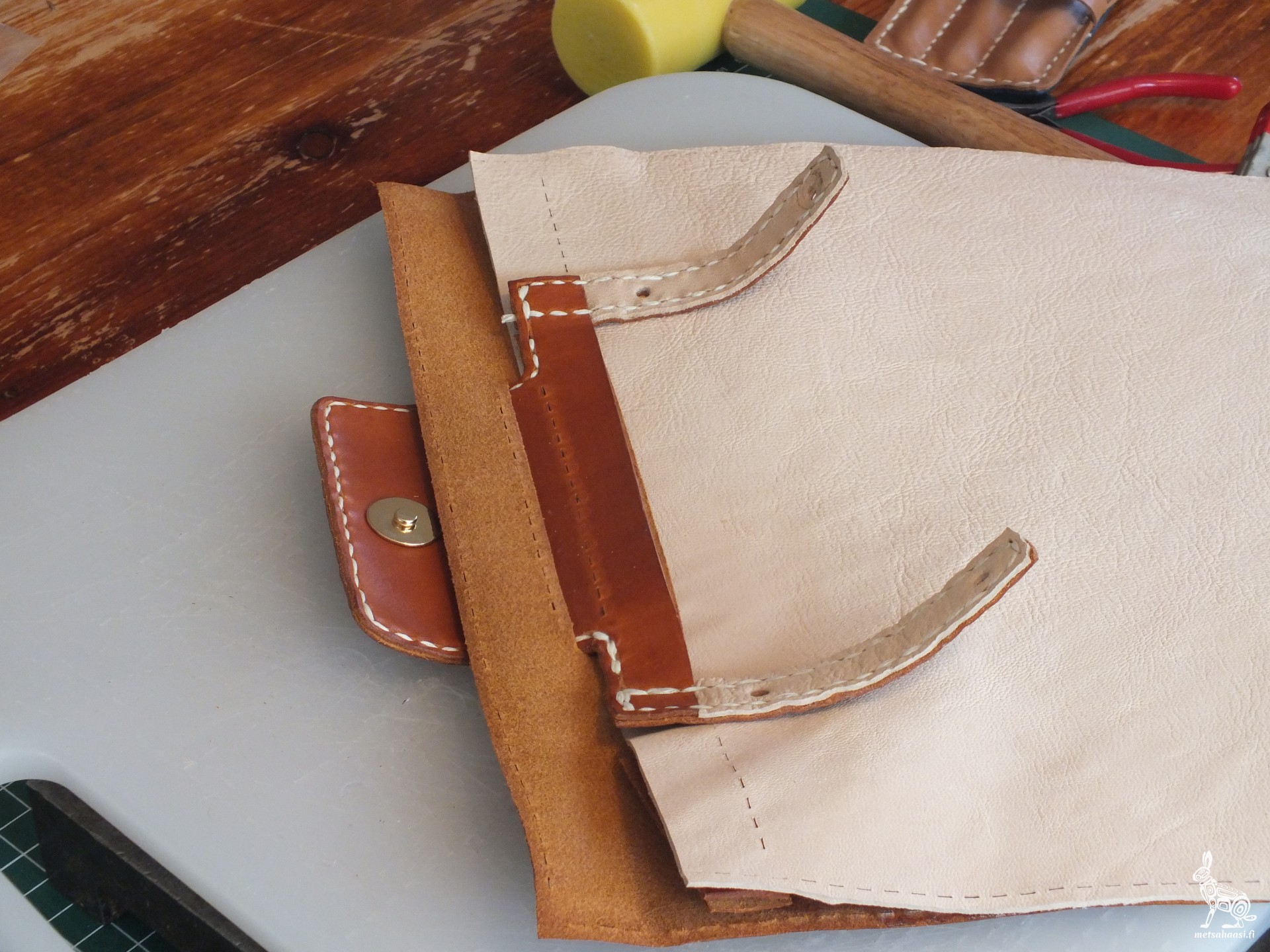
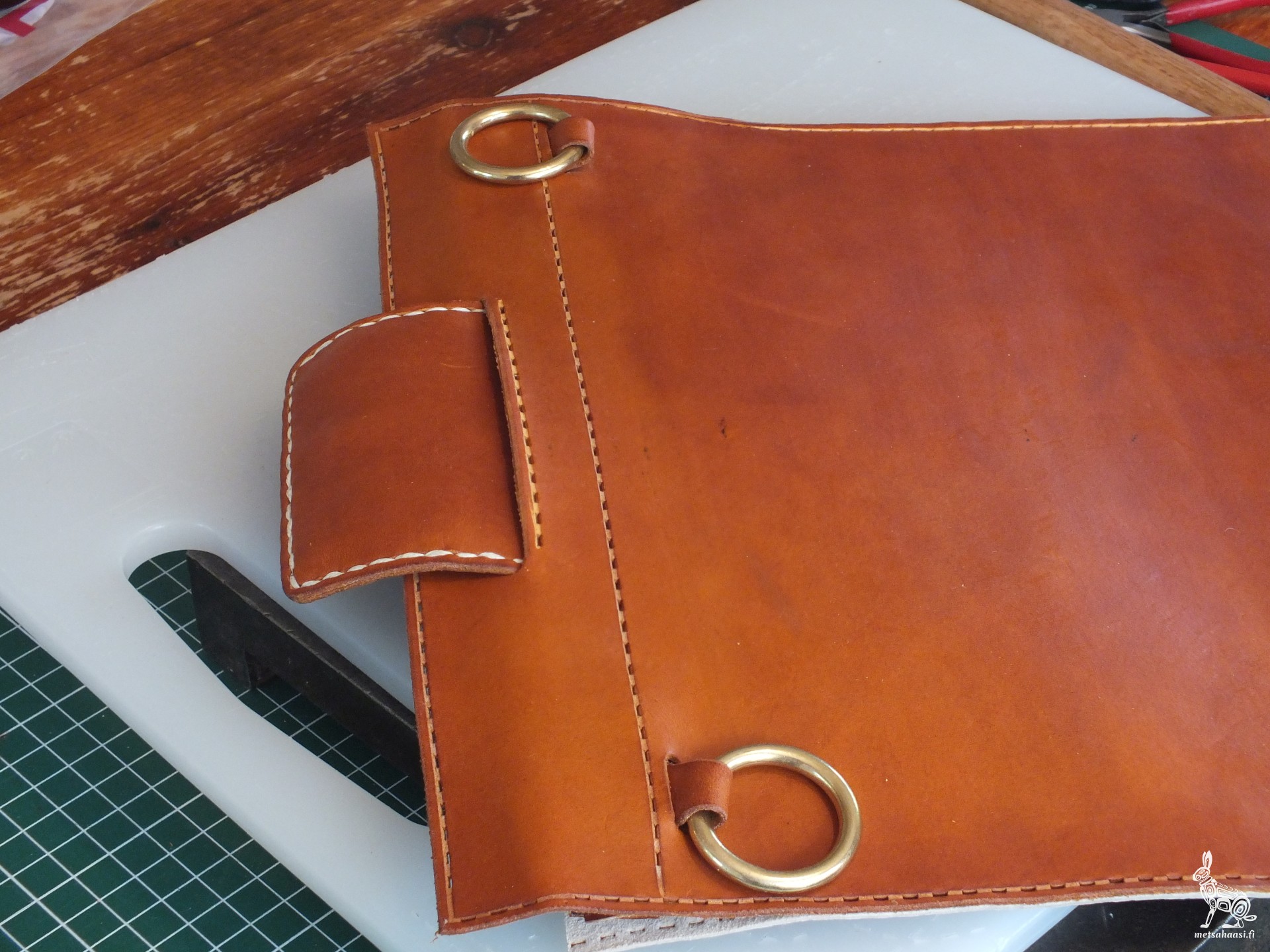
The rolled core stops about seven centimetres before each end. The leather continues flat, the two layers are glued together, folded around the solid brass ring and secured with a single brass rivet.
No elaborate attachment piece. No complicated stack of tabs and reinforcements.
Just one clean transition from round handle to flat leather to brass ring.
That was probably the most satisfying discovery of the whole build. After spending far too much time thinking about increasingly complicated solutions, the strongest and best-looking answer was also the most obvious once it appeared.
The interior pocket caused the opposite kind of problem.
The original brief called for a small zippered compartment sewn into the lining of the main bag. That is a common solution, but it has never been one of my favourites. In an earlier restoration I had already seen how an integrated pocket can pull and crease the lining, especially once objects are actually placed inside it.
More importantly, the zipper itself became a sourcing problem.
There are moments in leatherwork where an apparently minor component threatens to hold the entire project hostage. A zipper can be one of those moments.
Size, tooth width, tape colour, brass tone, sliders, stops, polished or unpolished teeth. What began as “I need a small zipper” briefly became an unwanted postgraduate course in zipperology.
If the pocket had remained integrated into the lining, I would have been forced to stop the whole build until every detail was solved, because the pocket had to be finished before the lining could be permanently attached to the bag.
So the design changed.
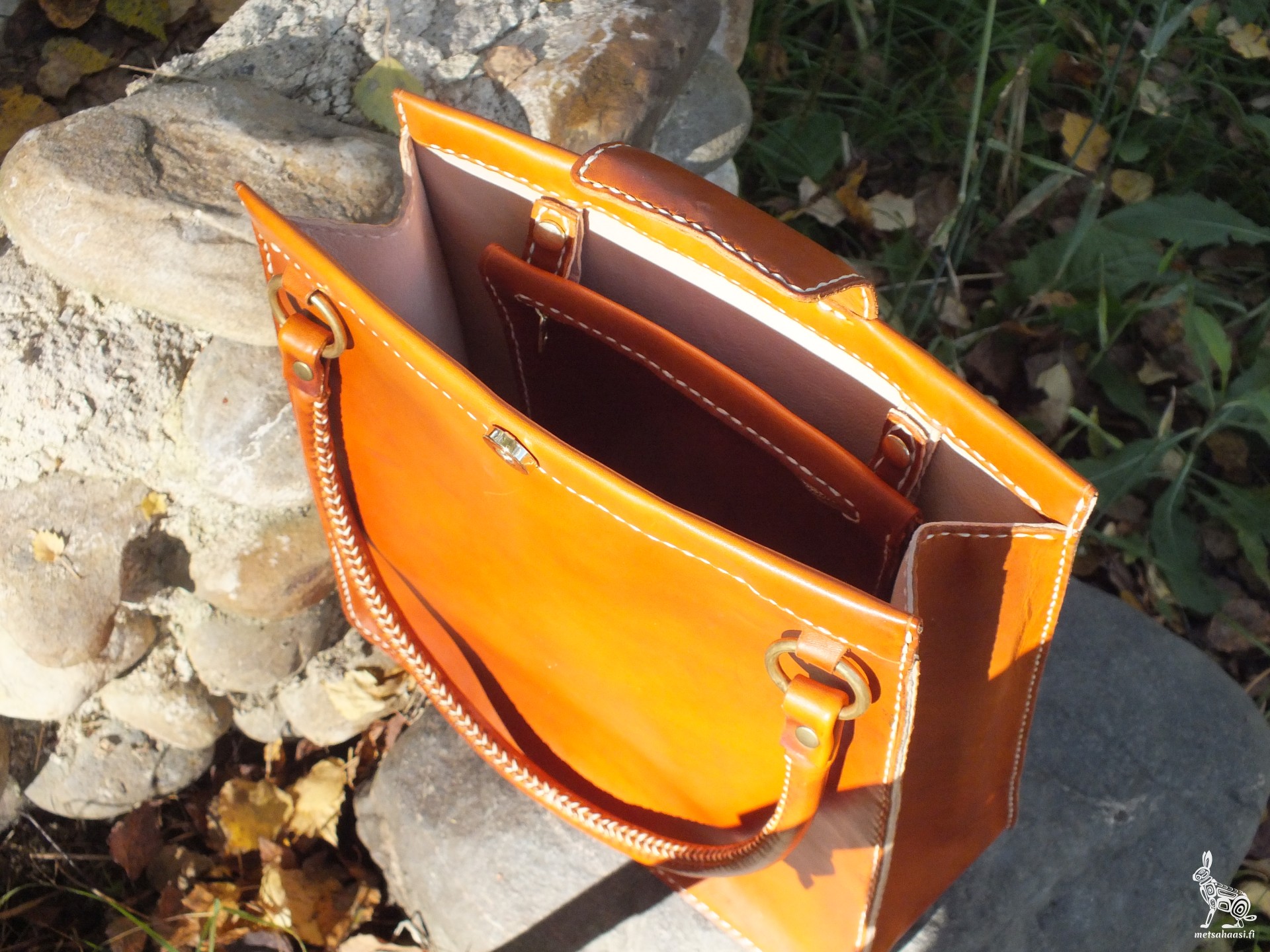
Instead of a fixed interior pocket, Petra received a separate removable pouch.
That one decision changed the project more than expected.
The pouch could be removed for cleaning. It could hold the small things that otherwise disappear into the depths of a handbag. It could potentially serve as a small evening pouch by itself. More importantly, the idea could be reused in other bags.
A small valuables pouch does not have to belong permanently to one handbag. It can move from one bag to another.
That opened the door to something broader than this one commission: a modular interior system.
The first version still uses snap-button loops to attach the pouch near the top of the bag. They work, but they are not the solution I would use again.
The next Petra will have two small brass D-rings integrated into the upper rim of the bag and two hooks on the pouch. The pouch can then be clipped in or removed in seconds. The same D-rings can hold a key keeper or some other accessory when the pouch is not used.
That is one of those details that barely exists visually, but changes how useful the bag can become.
The pouch itself also went through several lives before settling down.
At first I wanted to make it from two flat leather panels, sew them right sides together and turn the whole piece inside out so the seams disappeared.
The mock-up looked terrible.
So much for that idea.
Then I considered keeping the pouch completely flat. That looked clean, but it did not give enough room to comfortably reach inside. A phone, lipstick and a few small objects quickly turn a flat pocket into a leather envelope under strain.
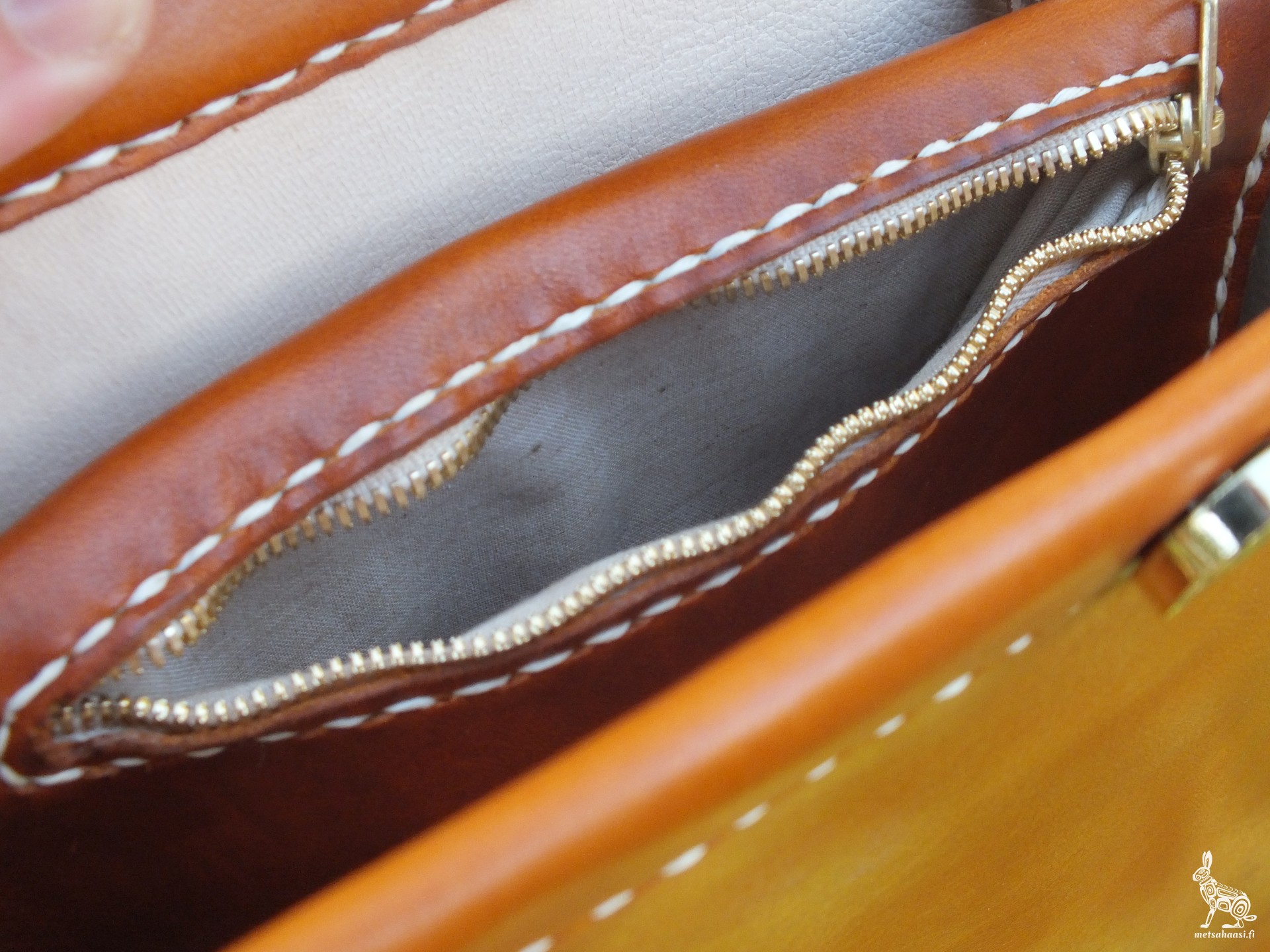
The answer was a very shallow gusset, only about 1.2 centimetres deep. Enough to give the pouch breathing room without turning it into a second handbag living inside the first.
The cotton lining, a lightweight organic Cretonne, worked beautifully. The pouch leather did not.
I had used the same 1.3 mm vegetable-tanned leather as the main bag. On the outer bag that thickness was ideal. Around a small zipper it was simply too stubborn. The zipper wanted to move slightly as it opened and closed; the leather refused. The result was some waviness and a less fluid zipping action than I wanted.
Next time the pouch will use approximately 1 mm leather.
A small change, but an important one.
That is probably the clearest lesson from Petra as a whole: the same material can be perfect in one part of a bag and wrong only twenty centimetres away.
By the time the bag was nearing completion, another temptation had appeared.
Version 2.
Every project eventually reaches a point where the next version starts whispering over your shoulder.
Better D-ring attachments. A refined pouch. Thinner leather around the zipper. Possibly a different closure. A standardized key keeper. Maybe a slightly improved construction detail here and there.
It became very tempting to reopen finished seams and turn Petra Version 1 into Petra Version 2 before Version 1 had even left the workshop.
That would have been a mistake.
At some point a prototype has to be allowed to become an object.
So I stopped improving and finished the bag.
The final Petra still carries some of the decisions that taught me what I will do differently next time. That is exactly what a first version should do.
What began as a seemingly straightforward tote-style handbag ended up taking around sixty hours of hands-on work, not counting the late-evening thinking, supplier hunting and construction puzzles that continued long after the tools were put away.
But the final result is calm.
And that is perhaps the nicest contradiction in handmade work.
The finished object does not show the false starts.
It does not show three versions of the handles, a rejected pouch mock-up, hours spent comparing zipper teeth, or the moment when a tiny attachment method seemed to require the intellectual resources of a suspension bridge.
It simply looks like a dark brown leather handbag with rolled handles, brass rings, a warm natural interior and a small removable pouch.
Exactly as it should.
The model is now called Petra, after the first person who commissioned it.
Version 1 is finished.
Version 2 already knows what it wants to become.